Speak Loud Without Saying a Word: The Body Language Secrets Casting Directors Notice Immediately
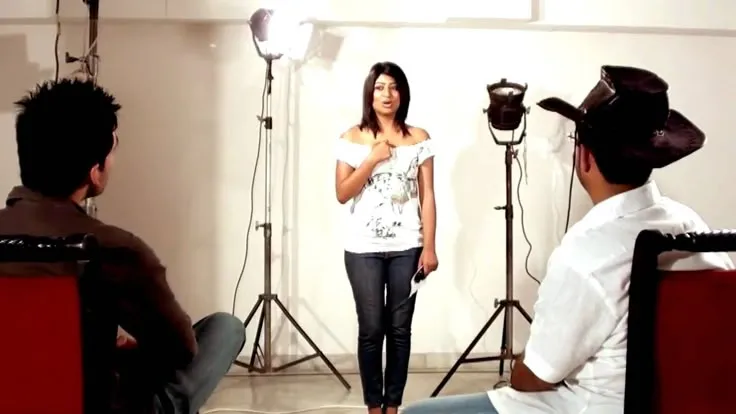
Photo: confident woman walking into audition room professional casting, via i.pinimg.com
You've rehearsed your lines. You've picked the perfect outfit. You showed up ten minutes early. But the moment you push open that door, the audition has already started — and you don't even know it yet.
Casting directors are professionals trained to spot talent fast. And one of the first things they're clocking? Not your headshot. Not your résumé. It's the way your body moves through the room before you ever open your mouth. If you're serious about breaking into modeling or performance, understanding the unspoken language of casting rooms isn't optional — it's essential.
The Waiting Room Is Part of the Audition
Here's something most aspiring talent don't realize: the tryout begins the second you walk into the building. Assistants, coordinators, and sometimes casting directors themselves observe how talent behaves while waiting. Are you hunched over your phone, shoulders caved in like you'd rather be anywhere else? Or are you sitting upright, relaxed but present, radiating the kind of quiet confidence that makes people look twice?
The waiting room is a pressure cooker, and your body responds to that stress in ways you might not notice. Crossed arms signal defensiveness. Leg-bouncing reads as anxiety. Slouching communicates disinterest. None of these are the vibes you want attached to your name before you've said hello.
Try this instead: plant your feet flat on the floor, keep your spine long, and rest your hands loosely in your lap or on your knees. Take slow, deliberate breaths. This isn't just performance — it actually calms your nervous system and shifts your energy in a way that's visible to everyone around you.
The Handshake, the Eye Contact, the Entrance
When your name is called, how you cross that room matters more than most people think. Walk with purpose, not urgency. There's a difference. Urgency looks frantic; purpose looks confident. Keep your chin parallel to the floor — not lifted arrogantly, not dropped submissively — just level and open.
The handshake, if there is one, should be firm but not aggressive. A limp grip suggests insecurity. A bone-crusher reads as overcompensating. Aim for a solid, brief connection, and pair it with direct eye contact and a genuine smile. That three-second combination — grip, eyes, smile — sets a tone that's incredibly hard to undo.
Eye contact deserves its own conversation. Sustained, warm eye contact communicates that you're present and engaged. Darting eyes suggest nervousness or dishonesty. Staring too hard comes off as intense or uncomfortable. Think of it like a conversation with a friend: natural, attentive, easy. That's the sweet spot.
Energy Management: What You Radiate Fills the Room
Casting directors often describe certain talent as having "it" — that magnetic, undeniable quality that makes you want to keep watching them. A huge part of that quality is energy, and energy is deeply tied to how you physically carry yourself.
High-pressure moments like auditions tend to shrink people. Shoulders creep up toward ears. Voices get quieter. Movements become small and apologetic. This is the body's stress response doing what it's designed to do — but in a casting room, it works against you.
The fix isn't to fake confidence you don't feel. It's to use your body to generate it. Research in behavioral psychology — including widely cited work by social psychologist Amy Cuddy — suggests that expansive, open postures can actually shift your internal state. Before you walk in, find a private corner (a bathroom stall works perfectly) and stand tall: feet shoulder-width apart, hands on hips, chest open. Hold it for two minutes. You'll be surprised how differently you feel when you step back into that hallway.
Micro-Expressions and the Details You Can't Fake
Beyond the big stuff — posture, handshakes, eye contact — there's a subtler layer of nonverbal communication that experienced casting professionals pick up on almost unconsciously. Micro-expressions are fleeting facial movements, sometimes lasting less than a second, that reveal genuine emotion. A flicker of doubt before you start your read. A flash of frustration when you stumble over a line. A split-second of disconnection when the director gives you a redirect.
You can't fully control micro-expressions, but you can reduce the negative ones by managing your internal state. If you walk into that room genuinely curious and engaged — not desperate, not terrified — your face will reflect that. Preparation builds confidence, and confidence minimizes the fear-based expressions that can undermine an otherwise strong audition.
Also worth noting: what you do after a mistake matters enormously. If you trip over a word or lose your place, the way your body responds in the next two seconds tells casting directors everything about how you handle pressure on set. A quick breath, a small smile, and a smooth continuation? That's professionalism. A full-body cringe and a spiral of apologies? That's a red flag.
Putting It All Together
Body language isn't about performing confidence you don't have — it's about removing the physical barriers that are blocking the confidence you already do have. You prepared for this. You belong in this room. Your body just needs to catch up with what your résumé already says.
Before your next casting call, run through this quick checklist:
- In the waiting room: Sit tall, breathe slow, stay off your phone.
- On the walk in: Move with purpose, chin level, shoulders back and down.
- At the introduction: Firm handshake, warm eye contact, genuine smile.
- During the read or walk: Stay open, avoid self-protective gestures like crossed arms or hunched shoulders.
- After a stumble: Breathe, reset, continue. Don't let your body announce the mistake louder than the mistake itself.
Your stage moment starts the second you arrive. Make sure your body knows that.